
What your poop is actually telling you
Let me be honest, most people don’t look at their poop, and if they do, they have no idea what they’re actually looking at. But here’s the thing, your stool is one of the most accessible, free, daily health assessments you have available to you. You don’t need a lab requisition for it, you don’t need to book an appointment, it’s right there, every single day (hopefully), giving you real information about what’s happening inside your body.
I get it, it’s not exactly dinner table conversation. But if you’d pay attention to a warning light on your car dashboard, you should probably be paying attention to this too. Because what shows up in the toilet bowl is the end result of your entire digestive process. We’re talking stomach acid production, enzyme output, bile flow, how well your small intestine is absorbing nutrients, how your large intestine is managing water balance, how fast or slow things are moving through, and what your gut bacteria are actually doing with the food you’re giving them. That’s a LOT of information sitting right in front of you.
And the thing most people don’t realize is that changes in your stool aren’t random. They’re not just “something you ate,” they’re signals. Specific signals from specific parts of your digestive system telling you that something is either working well or needs attention. The problem is that nobody teaches you how to read those signals. Your doctor probably isn’t asking you detailed questions about your bowel movements (and if they are, they’re a keeper!). So, most people either ignore what they’re seeing or assume that what is “normal for them” is actually normal. Spoiler alert: it might not be.
This is exactly why stool assessment is one of the first things I do with every single client. Before we run labs, before we talk about supplements, before we change a single thing in your diet, I want to know what’s coming out. Because that tells me what’s working and what isn’t. In this post, I’m going to walk you through what to actually look for when it comes to your stool. We’re covering shape, colour, frequency, transit time, and all the things you might see that you’ve probably been wondering about but never wanted to Google at work. By the end, you’ll know what healthy actually looks like, what the red flags are, and when it’s time to stop guessing and start getting real answers.
Why Your Poop Matters More Than You Think
Think of your digestion system like an assembly line. Food goes in at one end, and what comes out the other end is the finished product of every single step that happening along the way. If something goes wrong at any point on that assembly line, the final product is going to reflect it. That’s your stool. It’s not just waste, it’s a report card on how well your body is actually processing what you’re putting into it.
Let me break that down a bit, because most people have never thought about digestion beyond “I eat food and eventually I poop.” There is so much more happening behind the scenes.
It Starts Before You Even Swallow
Digestion actually begins in your mouth. Chewing mechanically breaks food down, and enzymes in your saliva start working on carbohydrates before anything even hits your stomach. This why eating on the go, barely chewing, or inhaling your lunch in five minutes fast can set the stage for problems further down the line. If your food isn’t broken down properly at this stage, every step after has to work harder to compensate. And spoiler, it usually can’t fully make up for it.
Your Stomach Is More Than a Holding Tank
Once food reaches your stomach, hydrochloric acid and pepsin get to work breaking down proteins and killing off pathogens that came in with your food. This is a big deal. If you stomach acid production is low (which is way more common than people realize, especially if you’ve been on acid reducing medications), proteins don’t get broken down properly, harmful bacteria that should have been neutralized get a free pass into your small intestine, and you end up with symptoms like bloating, heaviness after meals, and yes, changes in your stool. A lot of people assume they have too much stomach acid when the actual problem is they don’t have enough.
The Small Intestines Is Where Real Work Happens
This is where the bulk of nutrient absorption takes place. Your pancreas releases digestive enzymes to continue breaking down food, and your gallbladder releases bile to emulsify fats so your body can actually absorb them. If enzyme production is insufficient, or if bile flow is sluggish (hello, anyone without a gallbladder or with a sluggish liver), you’re not absorbing what you should be. Fats pass through undigested. Nutrients don’t get picked up. And what you see in the toilet starts to change. Greasy stools, pale coloured stools, and floating stools often trace right back to what’s happening here.
Your Large Intestine and Your Microbiome
By the time what’s left of your food reaches your large intestine, most of the nutrients have already been absorbed. This is where water gets reabsorbed, electrolytes are balanced, and your gut bacteria go to work fermenting fibre and producing short chain fatty acids that fuel the cells of your intestinal lining. This is also where things like transit time really start to matter. If stool moves through too slowly, too much water gets pulled out and things become hard, dry, and difficult to pass. If it moves through too quickly, not enough water gets reabsorbed and you end up with loose or watery stools. Your microbiome composition plays a massive role here too. An imbalance in your gut bacteria can directly affect how well this entire stage functions.
Why This Matters
The reason I’m walking you through all of this is because I want you to understand that when something looks “off” with your stool, it’s not random. It didn’t just happen for no reason. There is a specific breakdown happening at a specific stage of this process. Hard, pebbly stool tells you something different than yellow greasy stool, which tells you something different than stool with visible undigested food in it. Once you understand the assembly line, you can start to recognize where things might be going sideways. And that shift from “my stomach is just weird” to “something specific might actually be going on” is exactly where real progress starts.
This is also why a 10 minute doctor’s visit where someone tells you to eat more fibre and drink more water often doesn’t cut it. Not because your doctor doesn’t care, but because that advice assumes the problem is simple. And for a lot of people reading this, it’s not simple. It hasn’t been simple for a while. Your poop is trying to tell you that, and now you’re starting to learn how to list.
The Bristol Stool Chart: Your Starting Point
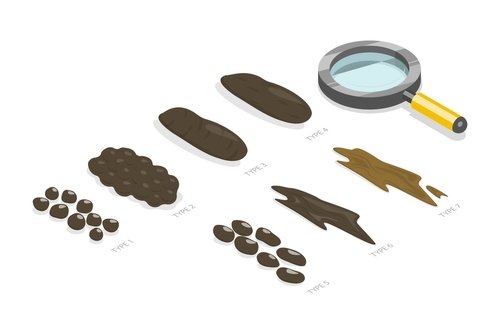
If you’ve ever Googled anything about your poop, you’ve probably come across the Bristol Stool Chart. It floats around the internet a lot (no pun intended), but most people have only seen it as a funny graphic and never actually learned how to use it. So, lets change that, because this is actually a validated clinical tool that was developed by researchers at the University of Bristol, and it’s one of the first thing I reference when I’m working with clients on their gut health.
The chart classifies stool into seven types based on shape and consistency. And each type tells you something specific about what’s happening with your digestion, your hydration, and how fast or slow things are moving through your system. Let’s go through them.
Type 1: Separate Hard Lumps
Think small, hard, individual pellets that are difficult to pass. This is a sign that stool has been sitting in your colon for way too long. The longer it sits, the more water your large intestine pulls out, and you’re left with dry, hard little lumps. This often points to slow transit time, inadequate water intake, low magnesium levels, or insufficient fibre. But before you reach for a fibre supplement, know that adding fibre to a system that isn’t moving well can sometimes make things worse. The “why” behind the slow motility matters.
Type 2: Lumpy and Sausage Shaped
This is essentially a bunch of Type 1 lumps that have stuck together. It’s still on the constipation end of the spectrum. Stool like this is often large, hard to pass, and uncomfortable. People who experience this regularly tend to strain on the toilet, which brings its own set of issues over time. Like Type 1, this usually reflects prolonged transit time and excessive water absorption in the colon.
Type 3: Sause Shaped with Cracks on the Surface
Now we’re getting into healthier territory. This is generally considered a normal, healthy stool. It has a defined shape, it’s relatively easy to pass, and the surface cracks suggest it’s been in the colon long enough to form properly but not so long that it’s dried out. If this is what you see most days, your digestion and motility are likely in a pretty good place.
Type 4: Smooth, Soft, Sausage or Snake Like
This is the gold standard. If your stool looks like this on a regular basis, your digestive system is doing its job well. Smooth, easy to pass, holds its shape. This indicates healthy transit time, adequate hydration, and good bile flow, and a microbiome that’s doing what it should be doing. This is what we’re working toward with clients.
Type 5: Soft Blobs with Clear Cut Edges
These are easy to pass, almost too easy. While this isn’t necessarily a crisis, it does lean toward the loose side and can indicate that things are moving a bit too quickly through the colon, or that something is mildly irritating the gut lining. If this is occasional, it’s probably nothing to worry about. If this is your everyday normal, it’s worth paying attention to what might be driving it.
Type 6: Mush, Fluffy Pieces with Ragged Edges
This is moving into diarrhea territory. Stool at this stage has passed through the colon too quickly for adequate water reabsorption. This can be driven by a lot of things: food sensitivities, bacterial imbalances in the gut, stress (your gut and your nervous system are deeply connected), infections, or inflammatory processes. People who live at Type 6 often think it’s just “how their body works,” but it’s usually a sign that something is actively going on.
Type 7: Entirely Liquid, No Solid Pieces
This is full blown diarrhea. Stool has essentially rushed through the entire large intestine with almost o water being reabsorbed. This can happen acutely with food poisoning or a stomach bug, but if it’s chronic or recurring, it’s a red flag for things like infections, parasites, significant food reactivity, or inflammatory conditions. This is not something to just live with or manage with Imodium indefinitely.
The Sweet Spot and What It Actually Means
So, you can see that Types 3 and 4 are where you want to be landing most of the time. But here’s what a lot of people miss. It’s not just about shape. Consistently being in that 3 to 4 range means that multiple systems are working well together. It means your stomach acid is doing its job, your enzymes and bile are flowing, your small intestine is absorbing nutrients properly, your large intestine is reabsorbing the right amount of water, and your microbiome is in a functional state. When all of these pieces are humming, your stool reflects it.
And on the flip side, consistently sitting at the extremes of this chart is your body’s way of telling you that one or more of those systems needs support. Not more Metamucil. Not more Imodium. Actual investigation into what’s driving the pattern.
One more thing that’s worth mentioning here. A lot of people focus only on frequency, as in “I go once a day so I’m fine.” But if that once-a-day bowel movement is a Type 1 or Type 2, that’s not fine. Frequency and form go hand in hand. Ideally, you’re having one to three well-formed bowel movements per day that fall in that Type 3 or 4 range and that pass without straining, urgency, or discomfort. That’s the full picture. Not just “did I go today” but “what did it look like and how did it feel.”
Colour: What It Means and When to Pay Attention
Now that you know what shape and consistency are telling you, let’s talk about colour. Because this is one of those things that can send people into a full panic spiral at 11pm on a Tuesday night, Googling “why is my poop green” while convincing themselves something is terribly wrong. Sometimes it’s nothing. Sometimes it’s something. The key is knowing the difference and understanding what each colour variation actually points to.
Your stool gets its colour primarily from bile. Bile is produced by your liver, stored in your gallbladder, and released into your small intestine to help break down and absorb fats. As bile travels through your digestive tract, it gets broken down by bacteria and enzymes and gradually shifts from greenish colour to the brown you’re used to seeing. So, when stool is healthy medium to dark brown, that’s telling you that bile production and flow are functioning properly, and that transit time is giving bile enough time to go through that full chemical transformation. Brown is the baseline, everything else is a deviation worth understanding.
Pale, Clay, or Light-Coloured Stool
This one always gets my attention clinically. If your stool is consistently pale, clay coloured, or almost grayish, that’s a sign that bile isn’t making it into your digestive tract the way it should be. Without adequate bile, your stool loses that characteristic brown colour. This can point to a sluggish gallbladder, bile duct obstruction, liver congestion, or in some cases, a need for deeper investigation into liver and gallbladder function. If you’ve had your gallbladder removed, this one is especially relevant to you because your body no longer has a storage reservoir for bile, which means bile flow is less concentrated and less efficient. Occasional lighter stools might not be a big deal, but if this is a consistent pattern, it’s telling you something about your biliary system that shouldn’t be ignored.
Yellow or Greasy Stool
Yellow stool, especially if it’s greasy, foul smelling, or tends to float, is often a sign of fat malabsorption. Remember how bile is essential for emulsifying fats so your body can absorb them? If bile flow is inadequate, or if your pancreas isn’t producing enough digestive enzymes (specifically lipase, which breaks down fat), those fats pass through undigested and show up in your stool. This is sometimes accompanied by an oily residue in the toilet or bowl or stool that’s difficult to flush. If this is happening regularly, it’s worth looking into pancreatic enzyme sufficiency, gallbladder function, and overall bile production. Your body needs those fats. If they’re passing straight through, you’re not just dealing with weird looking stool, you’re potentially missing out on fat soluble vitamins like A, D, E, and K, along with essential fatty acids that your body relies on for everything from hormone production to brain function.
Green Stool
Green is probably the colour that causes the most unnecessary panic, because a lot of the time it’s completely benign. If you ate a massive kale salad, a green smoothie loaded with spinach, or anything with green food colouring, your stool might show up green. That’s just pigment passing through. No drama. But if you haven’t eaten anything green and your stool is consistently green, that can indicate that things are moving through your system too quickly. Remember, bile starts out green and gradually turns brown as it gets processed. If transit time is too fast, bile doesn’t have time to fully break down, and you end up with a green stool. This is essentially your body tell you that the speed of your digestion is outpacing the chemical process that should be happening along the way. Stress, infections, and certain gut imbalances can all drive this.
Red Stool
Red stool understandably freaks people out. But before you spiral, think about what you ate in the last 24 to 48 hours. Beets are the most common culprit, and they can turn your stool (and your urine) a pretty alarming shade of red. Tomato skins, red peppers, cranberries, and foods with red dye can also be responsible. If you can trace it back to something you ate, take a breath. However, if there’s actually red blood in your stool or on the toilet paper and it's not food related, that’s worth paying attention to. Bright red blood typically points to something going on in the lower GI tract, things like hemorrhoids, anal fissures, or in some cases inflammation further up in the colon. It doesn’t always mean something serious, but it's not something to just shrug off either, especially if it’s recurring. Get it checked out.
Black or Tarry Stool
This is the one where I’ll be direct. If your stool is black and tarry with a stick consistency, and you haven’t been taking iron supplements or Pepto Bismol (both of which can turn stool black and are completely harmless), you need to see a doctor. Soon. Black, tarry stool can be a sign of bleeding up in the upper GI tract, meaning the stomach or upper portion of the small intestine. The blood appears dark because it’s been partially digested as it moves through the system. This not a “wait and see” situation and it’s not something to troubleshoot on your own. This warrants medical attention.
Pattern Matters More Than a Single Event
Here’s what I really want you to take away from this section. One weird coloured stool does not mean something is wrong. Bodies are variable. What you eat, how hydrated you are, medications, supplements, even stress can all temporarily influence stool colour. What you’re looking for is patterns. If your stool is consistently an abnormal colour, that is data. That’s your body communicating something specific about bile production, fat digestion, transit time, or the integrity of your GI tract. And that’s the kind of information that, when paired with right testing and clinical context, can actually lead to answers instead of just another round of “everything looks fine.”
Undigested Food, Mucous, and Other Things You Might See
Alright, let’s talk about the stuff that makes people do a double take in the bathroom. Because beyond shape and colour, there are other things that can show up in your stool that most people either ignore completely or quietly worry about without ever bringing it up to anyone. And I get it. “Hey, I noticed something weird in my poop” isn’t exactly a conversation starter. But these details matter clinically, and they’re often the things that give me the most useful information when I’m working with someone on their gut health.
Undigested Food
Let’s start with the one that throws people off the most. You eat a meal, and hours later, you can clearly identify pieces of that meal in the toilet. First, some of this is completely normal. Certain plant foods have tough outer casings made of cellulose that your body simply cannot break down. Corn is the classic example. If you see corn in your stool, that’s not a sign anything is wrong. Same goes for certain seeds, the skins of tomatoes or peppers, nut that weren’t chewed thoroughly, and leafy greens that made it through relatively intact. Your body took what it could from those foods and passed the rest. That’s just how fibre works.
Where it starts becoming more telling is when you’re regularly seeing larger, identifiable pieces of food that should have been fully broken down. Soft vegetables, meat fibres, or pieces of food that are clearly recognizable beyond just a tough outer skin. When it’s happening consistently, it usually points to one of two things. Either food isn’t being broken down properly in the upper part of your digestive system, which brings us back to stomach acid and enzyme production, or things are moving through too fast for complete digestion and absorption to happen. Sometimes it’s both. And the real issue isn’t just that it looks weird. If you’re seeing food come out looking similar to how it went in, your body didn’t get the nutrients from it. You could be eating the most nutrient dense diet in the world, but if your body can’t break it down and absorb it, you’re not actually benefiting from it the way you think you are.
One thing I always ask clients is how they’re eating, not just what they’re eating. Are you chewing thoroughly or swallowing half chewed bites because you’re eating while distracted, standing at the counter, or rushing between tasks? Because digestion starts in the mouth, and if you’re skipping that step, everything downstream has to compensate. It sounds overly simple, but I’ve seen noticeable changes in people’s stool just from slowing down and actually chewing their food.
Mucous
Seeing mucous in your stool can be unsettling, but small amounts is actually normal and healthy. Your intestinal lining produces mucous as a protective barrier. It helps stool move through smoothly and protects the delicate cells of your gut wall from mechanical damage and from direct contact with bacteria. So a thin coating of mucous that you barely notice is your body doing exactly what it’s supposed to do.
What’s not normal is visible, obvious mucous. If you’re seeing stringy, jelly like, or thick mucous in your stool or on the toilet paper, that’s a signal that your gut lining is under some kind of stress. Your body ramps up mucous production when something is irritating or inflaming the intestinal wall. That could be a food sensitivity that’s creating an ongoing inflammatory response, a bacterial or parasitic infection that the immune system is reacting to, or an imbalance in the gut microbiome that’s driving chronic low-grade irritation. In some cases, significant mucous can also be associated with more advanced inflammatory processes that need clinical attention.
The point is that mucous is a defense mechanism. If your body is producing a lot of it, it’s defending against something. And figuring out what that something is matters a lot more than just treating the symptom.
Oily or Floating Stools
We touched on this briefly in the colour section, but it’s worth addressing on its own because a lot of people notice this and don’t know what to make of it. Stool that consistently floats, leaves an oily film in the toilet bowl, or is noticeably greasy is a hallmark of fat malabsorption. Your body is supposed to absorb the vast majority of the fat you eat. When it can’t, those fats pass through and end up in your stool, which changes both the appearance and the way it behaves in water.
This goes back to bile and pancreatic enzyme function. If your bile flow is sluggish or insufficient, fats aren’t being emulsified properly and your body can’t break them down into absorbable components. If pancreatic lipase output is low, same problem from a different angle. Either way, the result is the same. Fat is making it all the way through your digestive tract without being utilized, and you’re losing out on a critical macronutrient and everything it carries with it.
I want to flag this one specifically because fat malabsorption tends to fly under the radar. People notice the floating or oiliness and think it’s just a quirk, or they assume it means they’re eating too much fat. But it’s rarely about how much fat you’re eating. It’s about whether your body has the tools to process it. And if it doesn’t, that’s not something that resolves on its own. That’s a functional issue that needs to be identified and addressed.
What These Details Are Really Telling You
None of these things, the undigested food, the mucous, the oily residue, are random. They’re not flukes and they’re not things you just have to live with. Each one points to a specific part of the digestive process that isn’t functioning optimally. And what I find the most of my clients is that by the time they’re noticing these things, they’ve actually been going on for a while. They just didn’t know it meant anything. Or they mentioned it to a healthcare provider and they were told it was just normal. It might be common, but that doesn’t make it optimal. And there is a big different between those two things.
Frequency and Transit Time: The Overlooked Essentials
This section is where a lot of people are going to have to rethink what they’ve been told is normal. Because when it comes to how often you poop, there is a massive gap between what’s considered “medically acceptable” and what’s actually optimal for your health. And transit time, which most people have never even thought about, might be one of the most underrated pieces of the gut health puzzle.
How Often Should You Actually Be Pooping?
If you ask the most conventional healthcare providers, they’ll tell you anything from three times a day to three times a week is within the normal range. And technically, by clinical standards, that’s true. But here’s where I push back. “Within range” and “optimal” are not the same thing. Going once every two or three days means that waste material, including metabolic byproducts, used hormones, and toxins that your body already packaged up for removal, is sitting in your colon for far longer than it should be. Your colon doesn’t just sit there passively holding stool. It’s actively reabsorbing water from that material. And when stool sits too long, your colon doesn’t just reabsorb water, it starts reabsorbing things that were supposed to leave.
This is where it gets important, especially for anyone dealing with hormonal issues. Your liver processes excess estrogen and packages it up to excreted through your stool. That’s one of the primary ways your body eliminates used estrogen. But if stool is sitting in your colon for two or three days, that estrogen can be deconjugated by certain gut bacteria and reabsorbed back into circulation. This is called estrobolome activity, and it’s one of the many reasons that gut health and hormone health are so deeply connected. So, when someone tells me they only go every few days but they feel fine, I hear that differently than they do. Because “fine” doesn’t mean that recirculation isn’t happening. It just means they’ve adapted to it.
Ideally, you’re having one to three complete, well-formed bowel movements per day. That’s not excessive, that’s your body efficiently processing and eliminating what it needs to. If that sounds like a lot compared to what you’re used to, that’s actually the point. What you’ve gotten used to might not be what your body actually needs.
On the Other End of the Spectrum
While constipation gets a lot of the attention, going too frequently or having consistent loose stools is equally worth addressing. If you’re running to the bathroom four, five, six times a day, or if urgency is a regular part of your life when you always need to know where the nearest bathroom is, that’s not just an inconvenience. That’s information.
Frequent loose stools can indicate your gut is reacting to something, whether that’s a food sensitivity creating an inflammation response, a gut bacteria imbalance (dysbiosis), an active infection, or a nervous system stuck in a stress response and fast tracking everything through before proper absorption can happen. People who deal with this often tell me they’ve just accepted it as part of who they are. “I’ve always had a sensitive stomach.” But having a sensitive stomach isn’t an identity, it’s a symptom…and symptoms have causes.
Transit Time: The Metric Nobody Talks About
Transit time is simply how long it takes for food to travel from the moment you eat it to the moment it shows up in your stool. And despite being one of the most practical indicators of digestive function, almost nobody knows theirs. The ideal transit time is somewhere in the range of 12 to 24 hours. That window means food spent enough time in your system for proper breakdown and nutrient absorption to happen, but not so long that waste is hanging around and being reabsorbed.
If transit time is significantly shorter than 12 hours, your body is rushing things through. That means less time for enzymes and bile to do their jobs, less time for your small intestine to absorb nutrients, and less time for your large intestine to reabsorb water. The result is loose, poorly formed stool and potentially compromised nutrient absorption, even if your diet is solid.
If transit time is significantly longer than 24 hours, things are stagnating. Stool is drying out, gas and bloating are building up from extended fermentation, and as we just talked about, things that were meant to be excreted are getting a second pass through your system. Neither extreme is where you want to be.
The Corn Test
Here’s something you can do right now that requires zero equipment, zero cost, and about 30 seconds of effort. Eat a tablespoon or two of whole corn kernels and note the time. Then watch for when they show up in your stool. Corn is perfect for this because your body can’t break down that outer casing, so it’s going to come out looking pretty much exactly how it went in, making it easy to spot.
If you see it in under 12 hours, things are moving too fast. If it takes longer than 24 hours, things are moving too slow. If it shows up somewhere in that 12-to-24-hour window, your motility is in a healthy range. It’s not a perfect clinical measure, but it gives you a practical, real-world snapshot of how your system is functioning. And for a lot of people, it’s the first time they’ve ever had any objective data about their own digestion. You can also use beets for this if you prefer, since they’ll turn your stool a reddish colour (some mistake for blood) that’s easy to track. Same concept, different marker.
Why This Is Foundational to Everything Else
I want to be really clear about something, and this is a principle that drives how I work with every single client. If your bowels aren’t moving properly, nothing else is going to work the way it should. You can take the best supplements in the world, eat a perfectly clean diet, address gut infections and rebalance your microbiome. But if your body isn’t eliminating efficiently, you’re building a shaky foundation. Waste products back up, toxins recirculate, inflammation builds, and any protocol you layer on top of that is going to be less effective than it could be.
This is why the first thing I focus on with clients, before we even look at stool test results, before we start any targeted gut work, is making sure drainage pathways are open and bowels are moving. It’s not the exciting part, but it’s the part that makes everything else possible. And when clients start experiencing what it actually feels like to have regular, complete, well-formed bowel movements, often for the first time in years, it changes their entire frame of reference for what “normal” can feel like.
What Your Poop Can’t Tell You (And What Can)
Okay, so by now you’ve learned a lot about what to look for in the toilet bowl. Shape, colour, frequency, transit time, the things that show up that probably shouldn’t. And honestly, that’s already more than most people will ever know about their own digestion. But I want to be straight with you about something important. As much as your stool can tell you, there are limits to what you can figure out just by looking. And those limits are exactly where a lot of people get stuck.
You can’t see bacterial overgrowths with the naked eye. You can’t see whether you have a parasite quietly setting up shop in your gut. You can’t see opportunistic pathogens that are crowding out your beneficial bacteria. You can’t see whether your secretory IgA, which is your gut’s first line of immune defense, is depleted from years of stress and chronic exposure to things your body has been quietly reacting to. You don’t see how well your pancreas or gallbladder are functioning. You can’t see markers of intestinal inflammation like calprotectin. And you definitely can’t see the balance, or imbalance, of the trillions of microbes that make up your gut ecosystem.
This is where functional stool testing comes in. And specifically, this is where the GI Map comes in. The GI Map is a comprehensive stool test that I run on every single client I work with, and it’s one of the most valuable stools in my practice. It used DNA based PCR technology to identify exactly what’s living in your gut, the good, the bad, and the opportunistic. It looks at pathogens, parasites, bacterial imbalances, fungal overgrowths like candida, markers of inflammation, markers of immune function, markers of digestion and absorption, and so much more. I’s the difference between guessing what might be going on and knowing.
When To Be Concerned vs. When to Be Curious
Let’s get practical for a minute, because I don’t want you to walk away from this post and either panic about every weird stool you’ve ever had or assume that nothing matters until you’re in a medical emergency. There’s a middle ground, and that’s where most people actually live.
Here’s a simple framework to help sort it out.
See a doctor sooner rather than later if you’re experiencing:
Persistent black, tarry stools that aren’t from iron supplements or Pepto Bismol. Visible blood in your stool, especially if it’s recurring or accompanied by other symptoms. A sudden, unexplained change in bowel habits that lasts more than two weeks with no clear cause. Severe pain accompanying bowel movements. Unintentional weight loss alongside digestive symptoms. These situations where you want a medical workup to rule out anything serious, and that’s not something to put off.
Worth Investigating with a function practitioner if you’re dealing with:
Chronic constipation or chronic loose stools that have become your normal. Stool that consistently falls outside the Type 3 or 4 range on the Bristol Stool Chart. Persistent bloating that’s tied to your bowel patterns. Visible mucous showing up regularly. Undigested food that you’re seeing on a regular basis. Oily, greasy, or floating stools that aren’t a one off. The feeling that you never fully empty when you go. Years of being told everything looks fine while you know something isn’t right.
This is the in between space. The pace where conventional medicine doesn’t have answer because, by their standards, nothing is “wrong enough” to investigate. But you know your body. You know things aren’t optimal. And you deserve to have someone actually look at the full picture instead of dismissing your symptoms or sending you home with another fibre recommendation. This is exactly the kind of work I do, and the kind of client I love working with, because there are real answers available. They just require the right tools and the right approach.
Conclusion
Your poop is talking to you every single day. The question is whether you’re listening. And now that you’ve made it through this post, you have the framework to actually understand what your body has been trying to tell you all along. You know what healthy stool looks like. You know what colour, shape, frequency, and transit time can reveal. You know what the red flags are and what’s worth paying attention to. You know that “normal for you” isn’t always the same thing as optimal., and you know that the things you’ve been quietly noticing in the bathroom aren’t random. They’re signs.
This information is free and it’s available every single day. It doesn’t require a lab requisition or an appointment or a single dollar spent. All it requires is that you start paying attention. For a lot of people, that shift in awareness is the very beginning of taking back control of their gut health.